Release requirements

We are purchasing through the online docking platform of
Buy Chemical Plastics.
Are you still searching for the product you have in mind?
Try "Posting Demands"!
Secured Trading

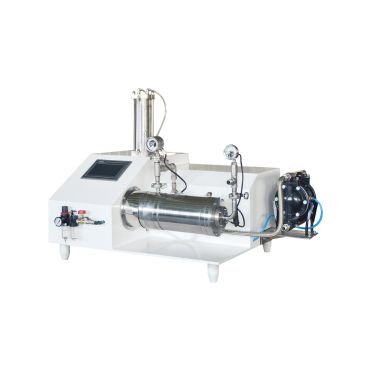
Horizontal Lab Mill

Price (tax incl.)
Negotiable (Subject to final quotation)
  • MOQ1 Set
  • Trade typeSpot Avail
SKU name Unit price(tax incl.) Stock Quantity
sku-1 Negotiable 1 Set

  • Tonghui horizontal lab mills are specialized equipment used for grinding, milling, and dispersing materials in laboratory settings. They are designed to process small amounts of materials efficiently, making them ideal for research, sample preparation, and small-scale production. Horizontal mills offer advantages such as uniform particle size distribution, high efficiency, and the ability to handle liquid into liquid and solid into liquid grinding processes.

  • Tonghui has two types of horizontal laboratory mills, each designed for specific applications and materials. 
  • Pin Type Lab Mill:
  • Features a rotor with a zirconia rod and pin structure with high linear velocity and produces a narrow particle size distribution.
  • It’s suitable for materials with various viscosities, including high-viscosity products.
  • Disc Type Lab Mill:
  • Equipped with multiple zirconia disc  grinding discs on the rotating shaft.
  • It’s suitable for lower viscosity material, and it’s easy to clean.

  • Features of Pin Type Lab Mill

  • Pin type lab mill uses high energy impacts to break down materials. It generates strong forces by colliding beads between rotating and stationary pins, making it ideal for ultra-fine grinding below 5μm and nano-sized particles. It works well with thick, high viscosity materials and tough substances, quickly reducing particle sizes due to its intense energy input. The results are extremely fine particles with a uniform size range, perfect for advanced applications like electronics, advanced ceramics, or specialty inks. However, it requires more precise control and is often used when strict particle size standards are needed.

  • Features of Disc Type Lab Mill

  • Disc type lab mill relies on friction between beads and rotating discs to grind materials. It’s better suited for coarser grinding 10-20μm and works efficiently with thinner, low-viscosity liquids mostly under 20,000 cps. The design is simpler, making it reliable and easy to operate for routine tasks. While it can’t achieve ultra-fine results like the pin type, it handles small batches and general applications like paints, coatings, or basic chemical processing. It balances decent fineness with lower costs and maintenance, making it a practical choice for industries where extreme precision isn’t required.

  • Lab Mill Industry Applications

  • ◆        Pharmaceuticals: Lab mills grind active ingredients or raw materials into fine powders for tablets, capsules, or drug formulations. This ensures even mixing and consistent dosage in medicines.
  • ◆        Food Science: Used to process spices, additives, or dried ingredients into uniform powders. For example, grinding coffee beans or creating powdered flavorings for snacks and beverages.
  • ◆        Materials Research: Prepares nanomaterials like graphene or ceramics by reducing bulk materials to nano-sized particles for testing in electronics, coatings, or advanced composites.
  • ◆        Cosmetics: Mixes and grinds pigments, powders, or base materials to create smooth foundations, eyeshadows, or skincare products with even texture and color distribution.
  • ◆        Environmental Testing: Crushes soil, sediment, or plant samples into fine particles for analyzing pollutants, nutrient content, or microplastic contamination in environmental studies.

  • Tonghui Horizontal Lab Mill Sepcifications
  • odelCDS-0.5CDS-1CDS-2
    Main power (kw)1.523
    Vessel capacity(L)0.512
    Maximun flow rate (L/h)0.5~22~105~20


Trade terms: FOB Language: 1